Filler Removal
If you have filler injected into your face and you do not like the results Mr Ferrando will be able to help you. As an expert in this field, he has solved many cases where filler has gone wrong and has removed filler even in patients that had very complex cases.
Understanding Fillers
The increased demand and growth for different types of fillers means that the complication rate linked to these injectables is also steadily increasing. Generally speaking, the body will naturally break down the dissolvable fillers over time however non absorbable fillers can remain in tissue forever and cause granulomas, deformity of the face, infection and reactions against these foreign bodies.
Dermal fillers are injected by needle or cannula by a fully qualified medical doctor with extensive training and in this way it’s possible to achieve very natural results. But injection fillers do carry risks and practitioners must know how to treat these complications should they arise. It is also their responsibility to make patients aware of these risks and complications.
Many of these issues can be resolved easily however complications caused by permanent fillers can be more problematic.
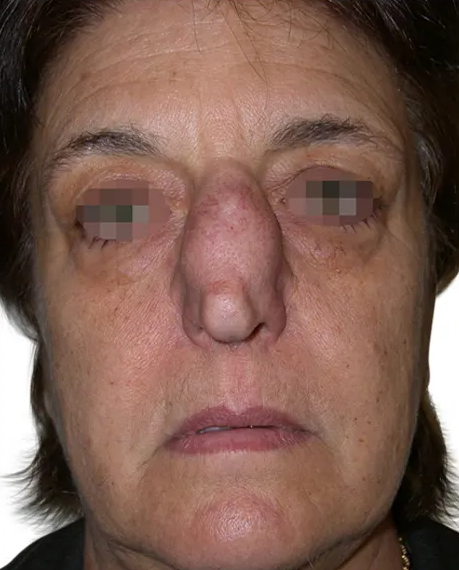
< before

after >
Knowing what to remove
Different fillers are suitable for particular areas depending on the texture and thickness of the skin and the depth of the filler required to correct volume loss. Different dermal filler products act in different ways. It is very important if you are having your filler removed that we know what product was injected so we know how to remove it. For complications arising from the use of permanent dermal fillers surgical removal may be the only option. Extensive knowledge of facial anatomy is required to carry out this complex procedure.
It is sometimes possible to remove re absorbable filler such as hyaluronic acid by simply injecting an enzyme which will destroy it. Other re absorbable fillers can be diluted and “ washed away” by injecting a saline solution. Permanent filler removal is much more complex. Silicone is undoubtably one of the most difficult products to remove because it spreads in tissue and can attach to the same tissues.
Simple cases removing fillers typically involves the use of hyaluronidase, an enzyme that breaks down hyaluronic acid-based fillers, which are the most commonly used fillers. The enzyme is injected into the treated area, and it works by breaking down the filler material over the course of a few days. Other types of fillers, add more challenging to be removed. They need different approaches, depends on the case to case. You can discuss with Mr. Ferrando, who is highly expert in any kind of filler removal.
Filler removal surgery is typically performed under local anesthesia and can be done as an outpatient procedure. The procedure itself usually takes only a few minutes to complete.
Recovery period can vary depending on the type and amount of filler that was removed. Some individuals may experience bruising, swelling, or discomfort in the treated area for several days after the procedure.
All surgeries carry certain risks and even though they are rare you should be aware of them before making your decision. Mr Ferrando will talk you through any possible risks and side effects at his consultations as they will vary depending on the patient’s anatomy, age, condition and lifestyle.During his procedures and treatments, he does everything possible to minimise the risk of complications by practicing a meticulously detailed approach and applying his world-class training background.