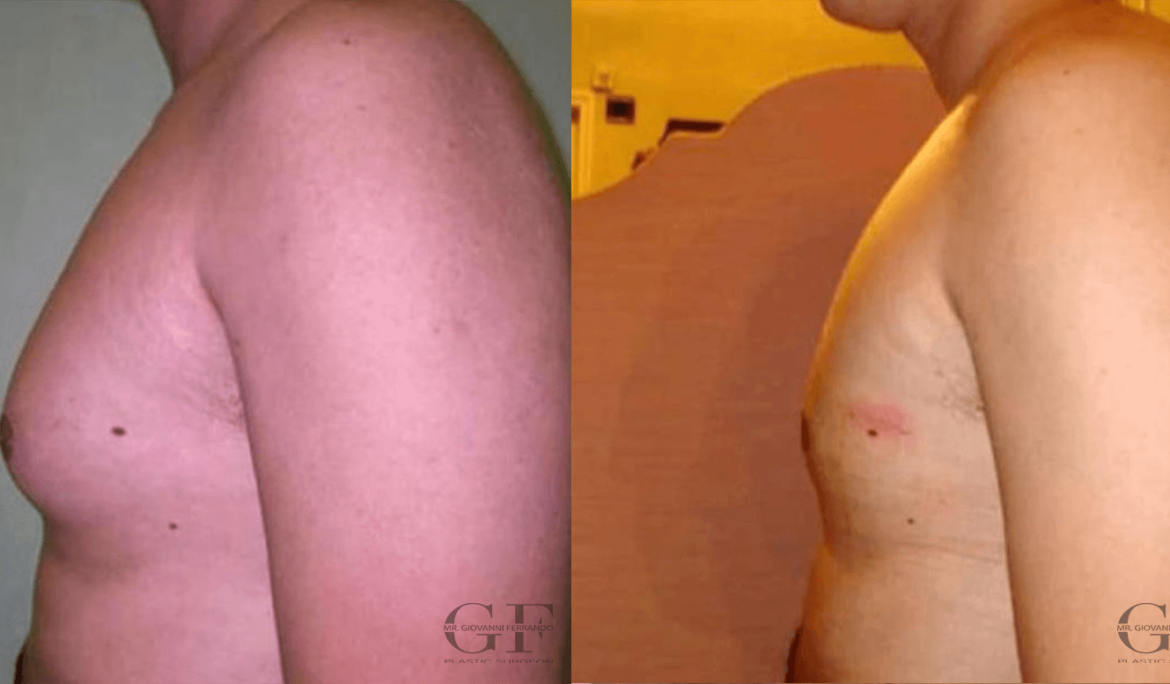
Gynaecomastia — enlargement of the male chest — is far more common than its profile in the UK suggests. Estimates place its incidence at up to one in three men at some point in life. Yet many British men live with it for decades, avoiding swimwear, layering shirts in summer, and quietly accepting it as something to be endured. It is not.
Gynaecomastia surgery is a straightforward, well-established procedure that resolves the condition definitively in one operation. This is what it involves.
The Two Causes Surgery Addresses
The male chest can become enlarged for two distinct reasons, and the surgical approach depends on which is responsible.
| Type | Cause | Surgical Approach |
|---|---|---|
| True gynaecomastia | Excess glandular breast tissue (firm tissue beneath the nipple) | Excision of the gland through a small periareolar incision |
| Pseudogynaecomastia | Excess fatty tissue, often weight-related | Liposuction alone |
| Mixed | Combination of both | Combined liposuction and gland excision (most common) |
Who Is It For?
The typical patient is a man between his late twenties and his fifties who has had the condition for years, has tried diet and exercise without resolution, and has decided enough is enough. Many patients describe the moment they decided to address it as long overdue rather than impulsive. It is not a procedure men book lightly.
The Procedure in Practice
Gynaecomastia surgery typically takes between one and two hours under general anaesthetic. Most patients go home the same day. A compression vest is worn for around four weeks, both day and night, to support the healing tissue. Discomfort is generally mild and managed with simple painkillers; significant pain is uncommon.
Recovery and Return to Normal Life
Office-based work resumes after seven to ten days. Driving usually returns within a week. Gym work — particularly chest and upper-body training — is restricted for six weeks. Most patients are wearing fitted T-shirts comfortably by the four-to-six-week mark and going topless on holiday by three months.
Discretion and the British Patient
One of the more frequent questions at consultation is whether anyone will be able to tell. The honest answer: in clothing, no. The scars are small and well-concealed at the nipple border. Even in close changing-room circumstances, what remains is a small mark that most men assume is a healed cut. The transformation is to your shape, not to your visibility.
Dr. Ferrando’s Approach
Dr. Giovanni Ferrando, FRCS (Plast), has performed gynaecomastia correction for over three decades. His consultations are direct and confidential. He examines, classifies the type of gynaecomastia present, and explains exactly what the procedure can — and cannot — achieve for your specific case. There is no template here; the result depends on accurate diagnosis.
Frequently Asked Questions
Will the condition return?
Once the gland is removed, it does not regrow. Significant weight gain or certain medications can produce changes, but a recurrence of true gynaecomastia is rare.
Is the scar visible?
The incision is placed along the natural border of the areola and typically heals to become inconspicuous.
What about exercise and weight training?
Light cardio resumes after two weeks. Chest, shoulder and upper-body training is restricted for six weeks to allow proper healing.
Is it covered by private insurance?
Some policies cover gynaecomastia where it has a documented medical or psychological impact. This is worth checking with your insurer before consultation.
References & Further Reading
Related articles from this clinic
External authoritative resources
Considering gynaecomastia surgery in London? Book a confidential consultation with Dr. Giovanni Ferrando. View examples in the gynaecomastia gallery or learn more about our men’s surgery services.