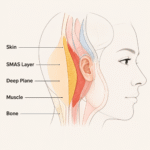
Most patients who eventually have a facelift describe a similar moment of recognition: a particular photograph, a comment from a friend, a fleeting glance in the mirror at an unflattering angle. The realisation that the face they are seeing is no longer the face they feel they have. Whether that moment justifies surgery, however, depends on what is actually happening to the tissues — not on the emotional response to it.
Here are five reliable indicators that surgical lifting, rather than further non-surgical work, has become the right answer.
1. Your Jowls Have Become a Defining Feature
Jowls are the soft tissue along the lower face that has slipped below the jawline. They appear as a slight overhang between the corner of the mouth and the angle of the jaw. Mild jowling can be camouflaged by careful filler placement or skin tightening. Once jowls are visible from any angle, are unmistakable in photographs, and have become something you actively notice when looking at yourself, filler is no longer the answer. The structural cause is descent, and only surgical lifting will address it.
2. Your Neck No Longer Matches Your Face
Many patients describe a sense that their face still looks reasonable but their neck has aged ahead. Vertical platysmal bands, a softening of the angle between chin and neck, loose skin under the jaw — none of these respond well to non-surgical intervention. A neck lift, often performed in combination with a facelift, addresses these changes directly.
3. Filler No Longer Lifts — It Just Adds Volume
| What You Notice | What It Means |
|---|---|
| Each filler session requires larger volumes for diminishing returns | The underlying tissue has descended past the point filler can support |
| You look fuller rather than refreshed after filler | Volume is being added but the structural problem remains |
| Friends comment that you look different rather than well | Cumulative filler is changing your face rather than restoring it |
| The same filler placement produces a softer, less defined result than it used to | Skin laxity has progressed; volume alone is no longer enough |
Many patients in their late forties and fifties have a moment where they realise filler is no longer doing what it used to. This is often the threshold at which the right next step is surgical assessment.
4. The Direction of Your Face Has Changed
Look at photographs of yourself from your thirties. The light reflects along an oblique, upward-sloping axis — high cheekbone, defined jaw, lifted brow. As tissues descend, the axis of the face slowly shifts horizontal, and then begins to slope downwards. The structure of how light reads your face changes. When this directional change is visible — when your face reads as “settled” rather than “lifted” in photographs — that is a structural change that only surgery can reverse.
5. You Look Tired Even When You Are Not
Patients often describe this most acutely. They are sleeping well. They are not stressed. And yet colleagues, family or strangers keep observing that they look tired. This is usually the cumulative effect of multiple changes — drooping brow, hooded lids, midface descent, jowl development — that read together as “tired” to other people. Once this is the consistent feedback you are receiving, the issue is no longer about being well rested. It is about facial structure.
The One Sign That Means You Are Not Yet Ready
The single most reliable indicator that you should not yet have a facelift is uncertainty. Patients who are happy with their result, ten years later, almost universally describe arriving at the decision over months or years — not weeks. If you are not sure, your first appointment is a consultation, not a surgery booking. A good surgeon will not pressure you to proceed and will often tell you to come back in a year if the timing does not feel right.
What a Sensible Consultation Looks Like
Examination. Honest assessment. Discussion of what surgery can and cannot do. Explanation of recovery, realistic outcomes, alternatives. A genuine answer to whether a less invasive option might still be appropriate. The conversation should be unhurried and consultative — and you should leave it with more information than you arrived with, not feeling pressured towards a decision.
Dr. Ferrando’s Approach
Dr. Giovanni Ferrando, FRCS (Plast), is unusual in how often he counsels patients against proceeding with surgery — at least not yet. His view is that the best facelift result comes from operating at the right moment, not the earliest possible one. He examines, listens, and frequently recommends a return in twelve or twenty-four months for patients who are not yet at the structural threshold.
Frequently Asked Questions
What is the right age for a facelift?
There is no right age. Most patients have their first facelift between fifty and sixty-five, but earlier and later cases occur. The right time is when the structural change merits the surgery — not when a chronological number is reached.
Will I look like myself after a facelift?
If performed conservatively by an experienced surgeon, yes. The aim is to reset your face by approximately a decade — not to change who you look like.
Can a facelift be revised later?
Yes. Secondary facelift surgery, performed years later, can extend results substantially.
What if I am not sure?
Book a consultation specifically for assessment. If you are not ready, a good surgeon will tell you so.
References & Further Reading
Related articles from this clinic
External authoritative resources
Considering a facelift in London? Book a consultation with Dr. Giovanni Ferrando for an unhurried, honest assessment. View results in the facelift gallery.
Helpful Resources & Next Steps: For patient results, explore our Before & After Gallery, discover our specialist post-treatment care including Regenerating Enhanced Filler Gel Serum, learn more in our Facial Rejuvenation section, read our companion guide: Facelift Recovery: Week by Week. To discuss your personal treatment plan, book a consultation with Dr Giovanni Ferrando.